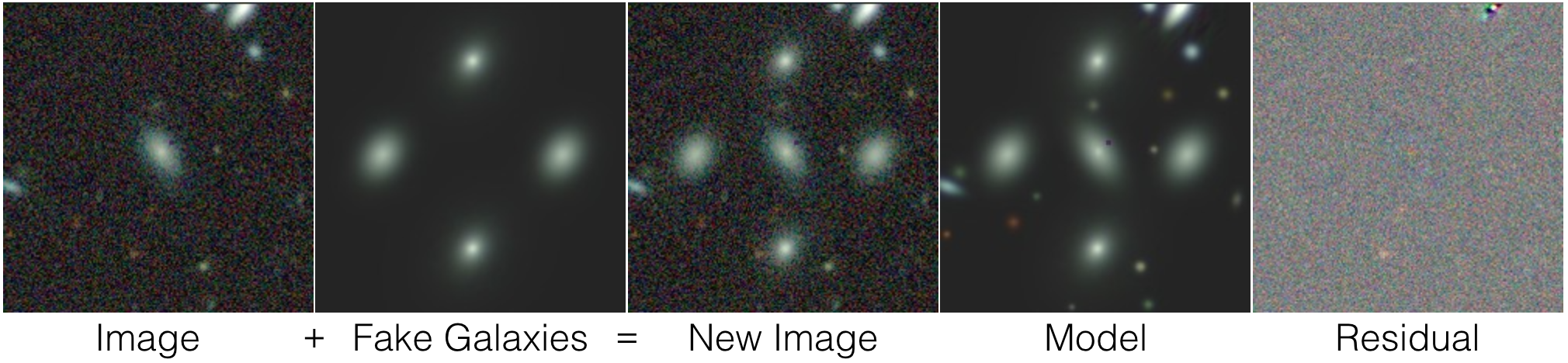
Obiwan is a Monte Carlo method for adding fake galaxies to Legacy Survey imaging data, running our Legacypipe pipeline, and repeating. The pipeline forward models sources in multi-wavelength images by detecting Signal to Noise (S/N) greater than 6 sources and minimizing the regularized L2 Loss function for various galaxy and star models.
The Legacy Survey is one of the first open source cosmological surveys. Anyone can download the raw and calibrated images from all three telescopes within a few days of being observed. Every six months, we publicly release the results of our Legacypipe pipeline.
A picture is worth a 1000 words
Why the name obiwan?
Just as Obi-Wan Kenobi was the only hope in Star Wars: Episode IV - A New Hope (youtube); obiwan, by virtue of its Monte Carlo method, is one of the only hopes for removing all systematics in the sample of galaxies we select from the imaging data.
These are commonly referred to as “imaging systematics” since they are related to image quality, the telescope, and the bias and variance of of the Legacypipe pipeline itself. The Sloan Digital Sky Survey (SDSS), showed that these “imaging systematics” could be removed by measuring correlations between the number of galaxies and image quality (namely, stellar density, seeing, galactic extinction, sky background, and photometric offsets). The situation is more complicated for the Legacy Surveys because our images come from three telescopes, and we take exposures of the same part of the sky, in multiple bands, over timescales of years. In addition, both the cosmological signal we are looking and the cameras on the telescopes we use, have physical size of about half a degree on the night sky (this is about the size of the moon seen from Earth).
How to run the code
See below for how to run obiwan using the National Energy Research Scientific Computing Center (NERSC) supercomputers.
Continuous Integration Tests
We use Travis to run end-to-end tests of obiwan. We add fake galaxies to small 200x200 pixel multi-color images, run the pipeline, then assert that the measured properties of the injected galaxies are within strict tolerances of what was added.
See the Tutorials here <end-to-end-tests> for more info.
Viewer
Our lead developer, Dustin Lang, made this amazing tool for looking at our imaging data:
Questions?
- desi-image-sims ‘at’ googlegroups.com
Acknowledgements
See the offical acknowledgements for the Legacy Survey.